
The Loneliest Sheep
Review: The Loneliest Sheep by Sionna Hurley-O’Kelly

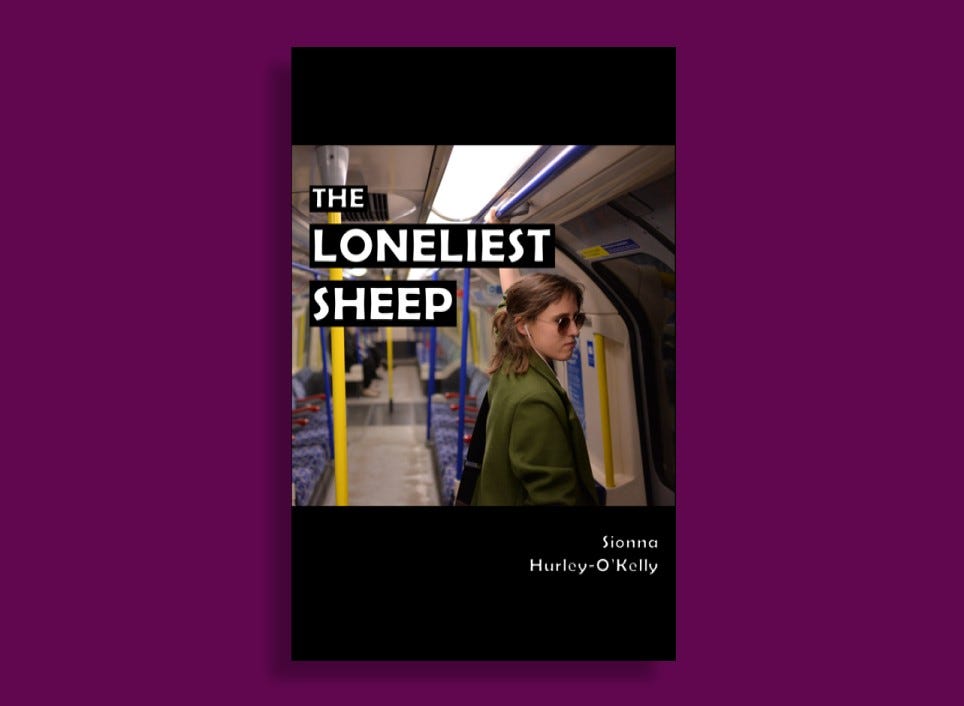
You’d think a book that has a title inspired by a solitary cliff-living sheep would be rural in character. Either an animal focused work in the style of Henry Williamson, or a gothic windswept romance (think something that would end up with a lambent Jacob Elordi playing the lead in a film adaptation). The Loneliest Sheep is neither.
It follows the young female narrator, starting out in London having recently finished university. Working in PR, the narrator moves between recognisable parts of central London and an equally recognisably dull flat. The description of that sort of early working life will ring true for many readers who are also trying to navigate that world. There are one or two details that slightly stretch reality – While Ye Olde Cheshire Cheese is a great pub, there are plenty of other good pubs nearer the narrator’s Covent Garden office, but perhaps the characters are less lazy in their after work drinking than I am.
A cynic might compare the narrator’s life to Hurley-O’Kelly’s and come to the conclusion that it is yet another novel closely tied to the author’s life, akin to a roman à clef, using fictional framings to retell the author’s experiences. However, as the novel progresses it becomes clear that there is far more going on than the typical ‘young-woman-navigating-the-world-of-work-and-relationships’ genre.
The Loneliest Sheep does not inhabit the world of American rom-coms in which people work in vaguely media related jobs, somehow in large apartments (they’re American remember) which are simultaneously near the office and Thames, and somehow only a half hour drive from unspoilt country cottages. This is a book firmly set in reality, and uses that to explore loneliness, isolation, and the curious modern conflict between an endlessly connected world and every more fragmented relationships.
To avoid spoilers, I will not go into too much depth plot-wise. I do though have to mention the narrators weekend trips to Knole park, which she does as a form of escape – and which provide the background for key moments of the plot. However, for all that it would be easy to see those trips to Knole as a simplistic escape, which also provides a foil to the city focused majority of the narrative, there is far more to it.
The narrator takes other trips out of London, and those in their rurality could be seen as fulfilling the same role, but it is telling that Hurley-O’Kelly chose Knole as the key place of respite. Hurley-O’Kelly taps into a vein than runs through a significant part of modern literature, particularly that of Virginia Woolf. Escaping from the city is a literary trope as old as cites, but the specific ideas of rurality present in female written modern literature is what is tapped into here. This is not the idea of a country retreat in the sense of a beautifully place to escape from work and entertain friends at but a more introspective idea of having one’s own space outside of the demands on normal urban domestic life.
People of the narrator (and Hurley-O’Kelly)’s generation cannot afford a room of their own, let alone the rural cottage as imagined in Woolf’s The Life of Violet or Sylvia Townsend Warner’s Lolly Willowes. Yet, for the price of a train ticket they can briefly purchase that escape to a form of rural life, albeit temporary, away from the pressures of the city and the contradictory heighten sense of loneliness that can only be felt in company.
For all those self-reflective, philosophical elements of the novel it maintains a good balance between serious thought and wit and entertainment. The chapter tiles, which lean heavily on allusions, are neatly witty – someone really ought to invent a ‘Empire of Rum’ cocktail – while also giving hints of what is to come. Perhaps the allusions at time are slightly self-indulgent, but it is a first-person narrative so they give an insight into the narrator’s mind.
Potentially the novel would have benefited from a tighter edit, tempering that self-indulgence, and evening the pacing, which eddies at times. With that said, it is a very readable book, that is hard to put down once started. I was also going to mention that there are one or two more typos than is ideal but that seems to be something common to all books now, those from established publishers and self-published alike
The allusions also do add an extra element of humour as the juxtaposition of someone who thinks in classical reference and a cat yowling “get ow-ow-ut” outside one of those dilapidated Victorian houses near the station in Hammersmith is hard to read without at least a bit of a chuckle.
There is also the entertainment of reading about the world of PR. You get just that hint of the gilded world it might once have been, with expense accounts, complimentary stays in glorious hotels, just so you can understand what you are writing about, and sense that you just rock up and write something clever before drifting off for a lunch meeting followed by a tad more networking over drinks. However, for the narrator there might be a reflection of a gilded world, but the gold leaf certainly doesn’t rub off on the junior staff. Theirs is a world of dull press releases, and carefully writing articles to be published in clients’ names.
That reality, tied to the allure of what things could be, gives a sense of hope. Hope that if only you work that bit harder, you might get the career you dreamt of (even if you never dreamt of the drudgery and so, so many pointless emails), but at what cost. Is it possible to have it all? A high-flying job but also relationships that work. The Loneliest Sheep holds the tension between expectation and reality firmly in the foreground. There is also keen pathos for a character who has a masters degree from one of the top universities in the world – at what cost I dread to think – but is stuck in a soulless job, that cannot fund more than a small maisonette, within earshot of the A4’s rumble, and that previously mentioned yowling cat.