
Molly, Etc.
Review: Molly, Etc. by Scott Elder

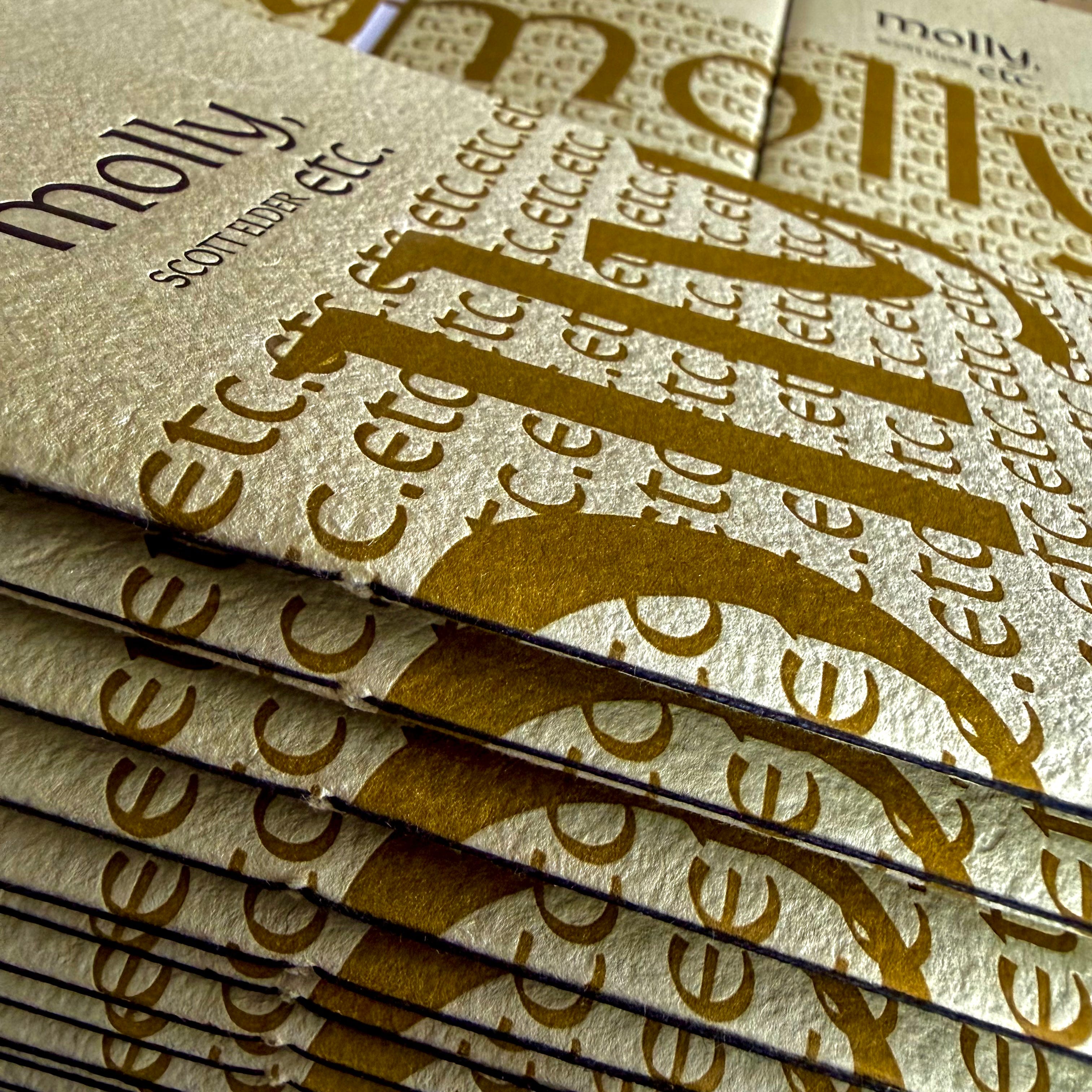
Most people choose a book by author, cover design, or perhaps a friend’s recommendation, but what drew me to Molly, Etc. by Scott Elder was the physicality championed by Rufus Books’s publisher Ágnes Cserháti. I was drawn to it having seen previous work published by Rufus Books, but also by the allure of the elegantly slim chapbook with visible texture to its cover.
I must confess that I am not always the most reverent when it comes to books. Far too many have accidentally joined me in cooling bathwater. Too many a paperback have been bent into a slightly too small coat pocket. Oh, and I do have a chair propped up by books in place of a leg that snapped. (But I’m not as bad as that editor who admitted on Twitter a few years back that he chopped up long books into shorter segments, just so they’d be easier to carry.)
However, that is how I treat normal books. Molly Etc. is one of those outliers, that reminds me that perhaps I should be more reverential of print. It is all too easy now to forget the effort and choices that goes into making a book, beyond simple commercial realities. That cover that drew me in is letterpress by Deborah Barnett of Someone Editions in a beautifully delicate green. It is very hard to describe without inviting you to run your fingers over it (which this medium sadly does not permit).
But it is not just the cover that has a physicality to it. The chapbook’s slightly elongated ratio creates an elegant shape that fits nicely in the hand, and, more importantly, fits the poems. Here there are none of those annoying bits when a poem doesn’t quite fit the page and so is either harshly truncated or drowned in excessive white space.
That format also provides the perfect form for such a collection. It is short enough to maintain thematic cohesion, without any poems being strong-armed to fit, or being broken into sections that only tangentially relate. Yet is long enough to give space for Elder to cover ideas from a poem of childhood school plays to a poem modelled after a Kate Bush song.
Molly, Etc. draws on the story of, the possibly fictitious, Molly Malone, as sung of in the famous ballad. That ballad is likely familiar to you even if the name doesn’t ring a bell. It’s also known as ‘Cockles and Mussels’ or ‘In Dublin’s Fair City’. What also might be lurking in your subconscious is that rather contentious 1980s’ statue by Jeanne Rynhart of the eponymous Molly. An image of that statue appears alongside the chapbook’s dedication. These are poems of and about Dublin.
The keen sense of place is maintained through the poems, even as they move from scene to scene jumping across time and perspective. Dublin remains in focus, even if sometimes only obliquely. Elder’s writing has a painterly almost cinematographic quality, cutting away the extraneous narrative, with striking imagery that provokes direct emotional responses rather than analytical thought.
That emotional link is inherently unstable, so each poem gains multivalence as with each reading the response is different, dependant on a reader’s mind at the moment of reading. It is not to say that the poems are vague and undecided, instead on each rereading you pick up a different facet of carefully etched prose, catching the changing light of your perspective.
Elder skilfully moves from form to form, with changing lineation and the judicious use of italics, to mirror the changing perspectives of each poem. His fluidity of style is given strength by the absence of punctuation. Save for the odd grammatically needed apostrophe or hyphen, there is no punctuation, leaving phrases to edge into each other as lineation and physical placement on the page take the place of commas and full stops.
Fluidity of style, however, is in and of itself unremarkable. It is the paring of stylistic fluidity with an ever-present sense of the ebbing and flowing water that gives these poems such an indelible sense of place. The images conjured by Elder might shift as he cuts from focus to focus, but they are never fully washed from memory. Meaning shifts and changes, but retains an underlying thematic link that binds these poems together.
That is rather apt for a collection named after a shifting story. Molly Malone has appeared in many forms, from 18th-century ballads, via an echo in Joyce’s Molly Bloom, to modern songs. The story changes but like good poetry has a multivalence that permits multiple meanings to co-exist rather than fight.
The ‘Etc.’ in the title would be easy to think of as an extra little particle used to give the poet a bit more scope when deciding what poems to include in the collection. But Elder is doing far more. He is playing with the idea of myth, of stories passed down over time, of characters that may be given new lives without eliding their past. This is a collection about Molly Malone and all the other Mollys that stick in the mind, in whichever form they are (re)imagined.